


Japanese Kitchen Knives: Essential Characteristics and Types for Every Chef
-

Kai Japan - Shun Premier Tim Mälzer - Tanto 25.5cm Anniversary Limited Edition - TDM-1785 - kitchen knives
Kai celebrates 15 years of collaboration with chef Tim Mälzer with a truly special limited edition: the Shun Premier Tantō TDM-1785 knife, produced in only 6,666 pieces worldwide.
Inspired by the traditional Japanese Tantō (短刀) sword, this model features a straight back and a sharp edge, making it ideal for slicing large vegetables, portioning meat, filleting fish, and much more.
The blade features the characteristic hammered finish typical of the Shun Premier series and is engraved with the special “15 The Legend” commemorative logo, alongside Tim Mälzer's signature. Each knife is individually numbered on the bolster, making it a true collector's item.
The design of the TDM-1785 was awarded the prestigious German Design Award 2025 in the “Premium Design” category.
Blade: VG MAX stainless steel Damascus with a hardness of 61±1 HRC.
Handle: Pakkawood.
Blade length: 255 mm.
Handle length: 120 mm.
Blade thickness: 3 mm.
Total length: 375 mm.
Weight: 220 g.
Notes: not dishwasher safe.TDM-1785€245.08Only 1 leftOnly 1 left
-

Kai Japan - Shun Pro Sho Yanagiba - VG-2006 - 26.5 cm - professional kitchen knife for fish, sushi and sashimi
The Shun Pro Sho series focuses exclusively on blades with asymmetrical sharpening, that is, traditional Japanese shapes. Due to the high quality of workmanship and materials, this series is particularly suitable for intensive professional use.
The knife's elegant design masterfully combines classic Japanese design language with Western components.
Key Features.
Use: Suhi and Sashimi (fish)
Steel: stainless steel with very high efficiency
Sharpening: asymmetrical, chisel-shaped
Wooden pakka handle: Traditional Japanese chestnut shape, resistant to use and moisture.
Continuous tang: Provides stability and balance.Blade: SOLID AUS10A stainless steel.
Handle: Black pakkawood
Blade length: 265mm.
Blade thickness: 3mm.
Total length: 405mm.
Weight: 200g.
Maintenance: hand wash, not dishwasher safeVG-2006€233.61Only 1 leftOnly 1 left -

Kai Japan - Seki Magoroku Kinju - Yanagiba Sashimi knife 27cm. - KK-0027 - kitchen knife
Knife with asymmetrical sharpening, not suitable for left-handed people
Seki Magoroku Kinju
The Japanese filleting knives of the Seki Magoroku KK Yanagiba series are characterized by a puristic design and the octagonal handle in matt black pakka wood.
The extremely long and slender shape of the blade allows for thin and precise cuts, perfect for filleting fish. The blade of the Yanagiba series is ground on one side, made of stainless carbon steel, which meets the strict European standards and decorated with a soft and wavy line in a satin finish. The KK series combines robust quality with understated functionality.
Use: fish (sashimi and sushi)
Blade: MV 58HRC stainless steel
Country of production: Japan
Handle: in pakkawood, octagonal, with black nylon bolster
Sheath / Case: not supplied
Blade length: 270mm
Total length: 400mm
Blade thickness: 3mm
Handle length: 127mm
Weight: 280gMaintenance: NOT dishwasher safe
KK-0027€106.56Only 1 leftOnly 1 left -

Zwilling - Miyabi 5000FC-D - Shotoh 110mm. 34680-110 - kitchen knife
Production: Japan
Blade: laminate with sharp steel FC61 to 61HRC and damask outer cheeks to 49 layers
Cut: Symmetrical
Construction: Forged
Grip: micarta
Blade length: 110mm.
Recommended use: vegetables, meats,Notes: developed in collaboration with Chef Rokusaburo Michiba
1006985Special Price €122.13 Regular Price €138.52Only 1 leftOnly 1 left
-

Global knives - GS57 - Mini Santoku Knife 11cm - vegetable kitchen knife
Mini Santoku with alveoli, ideal for cutting any food (fish, meat or vegetables).
The blade has grooves that allow excellent cutting smoothness, without the food going
glue to the blade.Blade length: 11cm
Total length: 23 cm
Weight: 82
GLOBAL Japanese knives are the favorite of Chefs in the most prestigious hotels and restaurants in the world.
The first GLOBAL knife was designed in 1985 by Komin Yamada, who gave the knife he created a new and revolutionary design.The main features of GLOBAL knives are:
- Lightness: GLOBAL was the first company in the world to make an empty steel knife in the handle. This feature allows you to reduce the weight of the knife by 30%.
- Manageability: thanks to the lightness and anatomical shape of the handle, GLOBAL knives lend themselves to continuous and prolonged times of use, minimizing user fatigue.
- Wire hold: GLOBAL knives are made using the best steels and the most modern manufacturing techniques. In the blades there is a high percentage of Molybdenum / Vanadium thanks to which the hardness of the steel reaches 56/58 Rockwell of hardness, consequently increasing the life of the wire.
- Sturdiness: being the GLOBAL knives completely in steel (both the handle and the blade) they are practically indestructible.
- Elegance
Awards acquired by GLOBAL knives:1990 - Japanese Good Design by MITI
1991 - Selected for International Design Year Book
1992 - Selected as Best Cooks' Knife in Benelux
1995 - Selected as Best Knife by WHICH Magazine in the UK
1996 - Selected as Sharpest Knife by A LA CARTE Magazine in GermanyAll Global products marketed by us are indelibly screen-printed with the Collini Cutlery logo (as in the image). This marking guarantees the buyer to have certainty on the quality, traceability, guarantee over the years and future privileged assistance on the product purchased from Coltelleria Collini.
GS57€69.26Only 2 leftOnly 2 left
-

Mcusta Zanmai - Beyond Sujihiki slicing knife 27cm - Aogami Super steel - ZBX-5011B - kitchen knife
The BEYOND series is the line of top-of-the-range professional knives produced by the Japanese MCUSTA ZANMAI for the year 2020.
The handles of the Beyond series are made of Hinoki wood and as per tradition have a decorative rivet with mosaic. The three-layer blade, with the two external stainless steel and the internal core in Aogami Super carbon (Super Blue Steel) is hardened to 62-63 HRC. Each knife is packaged in a wooden gift box with a bow.
Production: Semi-artisanal
Blade: 3-layer steel - stainless steel extrene plates, Aogami Super core (Super Blue carbon steel) 62-63 HRC
Handle: Hinoki wood
Blade length: 270 mm.
Blade thickness: 2 mm.
Total length: 432 mm
Weight: 180g.
Notes: not dishwasher safe
Packaging: elegant wooden boxSteel specifications:
Aogami Super (Hitachi Metals Ltd.) is one of the best Japanese carbon. In addition to containing more carbon, chromium and tungsten than Blue Steel, it also includes molybdenum. It has excellent cutting ability and excellent thread retention. Aogami Super is also capable of achieving high hardness without being brittle. Many knife enthusiasts consider Aogami Super to be one of the best high carbon steels in the world.
The city of Seki in Japan has been the center of producing the best Japanese blades since the mid-13th century. Natural choice thanks to its wealth of natural resources: sand, iron, coal and water, all important elements for the processing of blades. The techniques and skills of the ancient blacksmiths, handed down over the centuries, have currently been combined with modern technologies. The city of Seki still remains today the center of production of the best Japanese blades.
Mcusta knives are made in Seki and are the pinnacle of this synthesis between Japanese artisan tradition and modern technology. Each knife is assembled by hand, finished and checked by the craftsmen of the Mcusta team. Mcusta knives are considered among the best in the world!
Coltelleria Collini is the official distributor for Italy of MCUSTA Japanese knives
ZBX-5011 B€303.28Only 0 leftOnly 0 left Out of stock
 -

Mcusta Zanmai - Beyond Utility knife 11cm - Aogami Super steel - ZBX-5001B - kitchen knife
The BEYOND series is the line of top-of-the-range professional knives produced by the Japanese MCUSTA ZANMAI for the year 2020.
The handles of the Beyond series are made of Hinoki wood and traditionally feature a decorative rivet with mosaic. The three-layer blade, with the two external stainless steel and the internal core in Aogami Super carbon (Super Blue Steel) is hardened to 62-63 HRC. Each knife is packaged in a wooden gift box with a bow.Production: Semi-artisanal
Blade: 3-layer steel - stainless steel extrene plates, Aogami Super core (Super Blue carbon steel) from 62-63 HRC
Handle: Hinoki wood
Blade length: 110 mm.
Blade thickness: 2 mm.
Total length: 245 mm
Weight: 80 g.
Note: Not dishwasher safe
Packaging: elegant wooden boxSteel specifications:
Aogami Super (Hitachi Metals Ltd.) is one of the best Japanese carbon. In addition to containing more carbon, chromium and tungsten than Blue Steel, it also includes molybdenum. It has excellent cutting ability and excellent thread retention. Aogami Super is also capable of achieving high hardness without being brittle. Many knife enthusiasts consider Aogami Super to be one of the best high carbon steels in the world.
The city of Seki in Japan has been the center of manufacturing the best Japanese blades since the mid-13th century. Natural choice thanks to its wealth of natural resources: sand, iron, coal and water, all the important elements for the processing of blades. The techniques and skills of the ancient blacksmiths, handed down over the centuries, are currently combined with modern technologies. The city of Seki still remains today the center of production of the best Japanese blades.
Mcusta knives are made in Seki and are the pinnacle of this synthesis between Japanese artisan tradition and modern technology. Each knife is assembled by hand, finished and checked by the craftsmen of the Mcusta team. Mcusta knives are considered among the best in the world!
Coltelleria Collini is the official distributor for Italy of MCUSTA Japanese knives
ZBX-5001B€163.11Only 0 leftOnly 0 leftOut of stock -

Takefu Village - Takobiki Knife 260mm by Mr. Masanobu Okada - F-276R - kitchen knife
Takefu Knives Village is a brand born in 1991 in Echizen Fukui, a city in Japan famous since 1400 for the production of knives.
The Takefu knives brand is based on the union of 10 local artisans who make each knife by hand.The model presented is made by:
Mr. Masanobu Okada
Born in the city of Echizen in 1949, the third generation of forging artisans, he is one of the few living heirs of the "masaoki-ho" typical of Echizen, a forging technique that consists in hammering and folding the steel giving it a rhomboid shape for get a thinner, sharper and easier to sharpen steel sheet.Initially specialized in the production of agricultural tools with the Monjiro brand, in recent times he began to produce artisanal kitchen knives with the traditional "uchi-hamono" technique, also receiving the title of Dentoukougeishi (traditional craftsman) after having undergone the strict examinations of the commission of the Traditional Crafts Industry Promotion Association Foundation.
The uchi-hamono technique (uchi means blow and hamono means cutting tool) finds its origins towards the end of the 1300s, in the Muromachi period and consists of manually beating with a hammer and repeatedly a heated steel sheet until a blade of cut. Many tools made with this particular method are still on permanent display at the MoMA (Museum of Modern Art) in New York.
In a recent interview Mr. Okada said: "I have been engaged with this art for over 45 years, but still today I still think that it is an infinite world where the notions learned never become obsolete and for this I feel I have to transmit them. to the younger generations ". Currently, under his careful guidance, two apprentices are thoroughly learning the blade polishing techniques.
Characteristics of the knife:Use: meat / fish
Blade: CladSteel carbon steel with cutting edge in White Paper Steel (Shirogami) at 62 / 64HRC and damascus with 67 layers
Provenance Lama: Japanese craftsmanship
Handle: SandalWood, very hard and water resistant wood
Packaging: in cardboard with Japanese writing
Blade length: 265mm
Total length: 410mm
Blade thickness: from 3.5mm to 3mm
Handle Length: 139mm
Weight: 178g* Not every knife is signed on the blade by the craftsman who made it
Maintenance:
Considering the high carbon steel used for the blade and the extreme construction quality of these knives, we recommend a series of attentions to be followed to maintain the quality of the product over time.- Never put the knife in the dishwasher
- Rinse the knife with hot water before first use
- Rinse the knife immediately after each use without aggressive dishwashing detergent and dry with a soft cloth (always starting at the back of the cutting edge)
- Aggressive foods such as lemon juice must be promptly rinsed immediately after use
- Do not use glass or granite plates as a cutting support. Use only wooden bases
- Pay attention that the cutting edge of the knife does not come into contact with other metal objects during its storage to avoid damage to the cutting edge.
Invia commenti
Cronologia
Salvate
CommunityF-276R€311.47Only 0 leftOnly 0 left Out of stock
 -
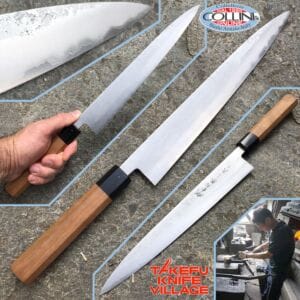
Takefu Village - Sujihiki Knife 270mm by Mr. Kanehiro Kintaro - kitchen knife
Takefu Knives Village is a brand born in 1991 in Echizen Fukui, Japan's famous city since the 1400s for knives production.
The Takefu knives brand is based on the union of 10 local artisans who make every knife by hand.The model presented is made by:
Mr. Kanehiro Kintaro
Kanehiro-san knives have gained popularity among professional chefs for the highest construction level and the high performance and cutting performance.
Knife Features:Use: meat / fish
Blade: Clad Steel (Steel Hammer Forged, San Mai) Steel with Aogami cutting edge super carbon steel core 62 / 63HRC with 3 layers
Origin Knife: Japanese craftsmanship
Handle: Cherry wood
Packing: in cardboard with Japanese writing
Length Blade: 265mm
Total Length: 417mm
Thickness Blade: 4mm to 1mm
Length Grip: 137mm
Weight: 154g* Not every knife is signed on the blade by the craftsman who made it
Maintenance:
Considering the high carbon steel used for the blade and the extreme construction quality of these knives, we recommend a number of attentions to keep in order to maintain the quality of the product over time.- Never put the knife in the dishwasher
- Rinse the knife with hot water before first use
- Rinse the knife immediately after each use without detergent for aggressive crockery and dry with a soft cloth (always starting at the back of the blade wire)
- Aggressive foods such as lemon juice should be rinsed immediately after use
- Do not use glass or granite plates as a cutting support. Use only wooden bases
- Take care that the knife blade wire does not come into contact with other metallic objects during its storage to prevent damage to the blade.D-507€241.80Out of stock -
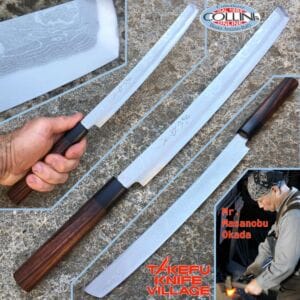
Takefu Village - Takobiki Knife 270mm by Mr. Masanobu Okada - kitchen knife
He was born in 1949 and is the 3rd generation of Okada Uchihamono. He is originally a blacksmith of gardening tools such as a sickle. In recent years, he has started to produce unique kitchen knife like your bought Takobiki. The Traditional Craftsman is the so-called Dentoukougeishi (Traditional Craftsman) which is the Accreditation Examination conducted by the Traditional Crafts Industry Promotion Association Foundation in accordance with Section 8 of Section 24 of the Act on Promotion of Traditional Craft Industries
Knife Features:
Use: meat / fish
Blade: CladSteel carbon steel with 62 / 64HRC White Paper Steel (Shirogami) cutting edge and 33-layer Damask "Suminagashi"
Origin Knife: Japanese craftsmanship
Handle: SandalWood, very hard and water resistant
Packing: in cardboard with Japanese writing
Length Blade: 265mm
Total Length: 410mm
Thickness Blade: 3.5mm to 3mm
Length Grip: 139mm
Weight: 162gF-416€311.47Out of stock -

Takefu Village - Yanagiba Sashimi Knife 270mm by Mr. Hideo Kitaoka - kitchen knife
Mr. Hideo Kitaoka
He was born in 1950 and is the 3rd generation of Kitaoka Hamono. He has been a specialist of Kataba (single-beveled) knife from the beginning. He is also Dentoukougeishi.Use: meat / fish
Blade: CladSteel carbon steel with 62 / 64HRC White Paper Steel (Shirogami) cutting edge and 33-layer Damask "Suminagashi"
Origin Knife: Japanese craftsmanship
Handle: SandalWood, very hard and water resistant
Packing: in cardboard with Japanese writing
Length Blade: 257mm
Total Length: 410mm
Thickness Blade: 4mm to 1.5mm
Length Grip: 139mm
Weight: 184g* Not every knife is signed on the blade by the craftsman who made it
C-804€303.28Out of stock


