


Collection Knives: For Knife Collectors and Custom Knife Enthusiasts
-
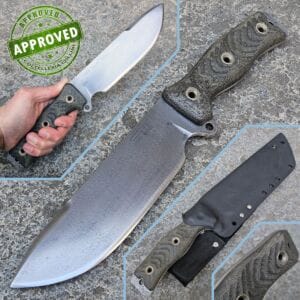
Busse Combat - SARsquatch 2008 Special Edition - INFI Steel & Raptor Micarta - PRIVATE COLLECTION - Knife
KNIFE PREVIOUSLY PURCHASED, FROM A PRIVATE COLLECTION
* Provenance: Acquired from a private individual; previously purchased and used
* Condition: Structure intact, no functional compromises, fully operational and ready for use. Presence of surface oxidation and signs of aging, consistent with the untreated finish. The absence of a coating has allowed, over the years, the development of a natural patina and signs of oxidation that attest to the authenticity of its use. These elements reinforce its technical character and ensure its longevity.
* Commercial Availability: Discontinued
* Sharpening: Professionally resharpened
* Blade Markings: Surface oxidation and signs of aging
* Handle Markings: None
* Box: /
* Sheath: Handcrafted Kydex, made specifically for this knife
* Manuals, Certificates, and Warranties: /
* Inspected and Certified by our in-house laboratoryThe Busse SARsquatch is one of the most iconic models in the Busse Combat Knife Company’s lineup, a direct expression of the design philosophy developed by Jerry Busse: maximum reliability, uncompromising construction, and proven performance in the field.
This specific 2008 Special Edition version stands out for its less common configuration, lacking a protective coating. A choice that at the time favored a more “bare and functional” approach, now particularly appreciated by the most experienced enthusiasts.
For many collectors and users, the SARsquatch represents one of those models that, during its production run, were difficult to find and even harder to purchase. An iconic piece from an era when Busse operated with limited availability and extremely high demand.
At the heart of the SARsquatch is the famous INFI steel, a proprietary alloy developed in-house by Busse, the specific composition details of which have been deliberately kept confidential over time.
In practice, INFI is recognized for: High resilience, suitable for intensive and heavy-duty use; Corrosion resistance superior to the average for non-stainless steels; Good edge retention, with ease of maintenance.
These qualities have helped build the brand’s reputation, making Busse models practical tools for real-world use.
This SARsquatch model is aimed at an audience that understands the value of the Busse project and the context in which it was born. It is not a pristine “collector’s item,” but an authentic knife, true to its operational nature.
It represents a tangible opportunity for those who, in the 2000s, followed the brand and appreciated its products but were unable to easily acquire them: today, it is possible to purchase an original piece, with a distinctive configuration and a history already written, ready to continue being used.
Intended Use: Heavy Duty
Production Type: Handcrafted
Country of Origin: USA
Blade: Full tang, INFI steel at 58/60 HRC
Blade Finish: Uncoated
Handle: Micarta with Raptor-style pattern, secured with 3 pin tubes
Blade Length: 185mm.
Blade Thickness: 5mm.
Overall length: 320 mm.
Balance: Guard-side balanced
Weight: 484 g.
Sheath: Handcrafted Kydex, made specifically for this knife; with modular attachment for vertical belt carry
Packaging: -
Notes: Knife from 2008, previously purchased, from a private collectionBU-SAR08-CP€749.00Only 1 leftOnly 1 left -
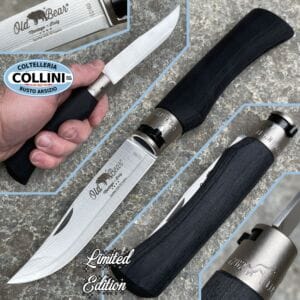
Antonini knives - Old Bear knife in SanMai VG10 a 67 layers - 23cm - multilayer black - Limited Edition
Antonini artisans from Maniago have created an exclusive and limited series of OLD BEAR knives using the famous Japanese SANMAI steel in VG10 with 67 layers. This beautiful project combines the tradition of a successful knife, patented and built in Italy, with the history and qualitative excellence of Japanese steel, made with a production process that dates back to that used for the famous Japanese swords.
The thickness of the blade goes from 2 mm of the standard models to 2.5 mm of this exclusive series, in order to make the knife more robust and performing.
To make the knife even more exclusive, for each of the three sizes offered, 60 exclusive pieces have been created, with progressive numbering engraved on the blade
Type of production: semi-artisanal
Production Lama: Italy
Blade: San Mai 67 VG10 damask stainless steel (60/61 HRC)
Handle: in plywood with satin brass ring with nickel plating
Blade length: 100mm.
Blade thickness: 2.5mm.
Closed length: 127mm.
Thick when closed: 22mm.
Total length: 225mm.
Weight: 68g.
Closure: viro blockThe handles are made of Italian olive wood. Being a model without return spring, the fixing of the blade to the handle is ensured by a solid safety ring in nickel plated brass equipped with a special locking device (covered by patent n. active partner of this project) which can be activated both in the open and in the closed position.
As early as 1100, expert Japanese blacksmiths combined different materials together to give Katana swords cutting, strength and flexibility previously unknown. Inspired by this tradition, Berkel has created a series of Japanese SanMai steel knives.
The blade consists of a core layer of extremely hard VG-10 steel, which keeps it sharp for a long time, and two outer plates made of 33-layer damask stainless steel per side, for greater resistance to corrosion and torsion.
Characteristics of SanMai steel: These are different types of metals bonded together to create a composite that encloses and intensifies the strengths of the metals individually taken:
- Longer life of the cutting edge
thanks to the use of very high quality steels with high carbon content (VG10, CoS, Shiro) or sintered (SPG2), in the heart of the sheet (Core Steel), the blade, once hardened, achieves decidedly hardness and cutting performance higher than those achieved with the use of traditional steels.- Greater resilience
built with the principle of Japanese swords, multilayer steel is difficult to break thanks to the toughness of the central steel (Core Steel) and the elasticity of the steel used for the side facing (Stainless Steel).- Better corrosion resistance
the steel used for the external layers (Stainless Steel) guarantees the blade a high resistance to corrosion. The combination of the two or more materials used by Takefu Steel generates, at the galvanic level, a structure that improves the corrosion resistance even on the wire.- Easy processing even after heat treatment
although steel normally becomes harder after hardening, the lateral steel used in multilayer processing does not lose its softness and allows easy processing, drilling or welding even after heat treatment. For an optimal performance of the blade, cryogenic treatment is recommended.- Improvement of the aesthetic result
The knives made with multi-state steel or damascus pattern at the end of the processing are aesthetically elegant, refined and highly appreciated by collectors all over the world.For more information: Collini Steel
AE-9305/23_MNK€127.05Only 18 leftOnly 18 left
-
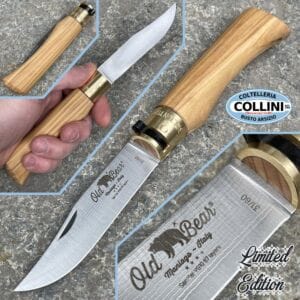
Antonini knives - Old Bear knife in SanMai VG10 at 67 layers - 21cm - olive tree - Limited Edition
Antonini artisans from Maniago have created an exclusive and limited series of OLD BEAR knives using the famous Japanese SANMAI steel in VG10 with 67 layers. This beautiful project combines the tradition of a successful knife, patented and built in Italy, with the history and qualitative excellence of Japanese steel, made with a production process that dates back to that used for the famous Japanese swords.
The thickness of the blade goes from 2 mm of the standard models to 2.5 mm of this exclusive series, in order to make the knife more robust and performing.
To make the knife even more exclusive, for each of the three sizes offered, 60 exclusive pieces have been created, with progressive numbering engraved on the blade
Type of production: semi artisanal
Production Lama: Italy
Blade: San Mai 67 VG10 damask stainless steel (60/61 HRC)
Handle: olive wood
Blade length: 90mm.
Blade thickness: 2.5mm.
Closed length: 120mm.
Thick when closed: 22mm.
Total length: 212mm.
Weight: 65g.
Closure: viro blockThe handles are made of Italian olive wood. Being a model without return spring, the fixing of the blade to the handle is ensured by a solid brass safety ring equipped with a special locking device (covered by patent n. of this project) which can be activated both in the open position and in the closed position.
As early as 1100, expert Japanese blacksmiths combined different materials together to give Katana swords cutting, strength and flexibility previously unknown. Inspired by this tradition, Berkel has created a series of Japanese SanMai steel knives.
The blade consists of a core layer of extremely hard VG-10 steel, which keeps it sharp for a long time, and two outer plates made of 33-layer damask stainless steel per side, for greater resistance to corrosion and torsion.
Characteristics of SanMai steel: These are different types of metals bonded together to create a composite that encloses and intensifies the strengths of the metals individually taken:
- Longer life of the cutting edge
thanks to the use of very high quality steels with high carbon content (VG10, CoS, Shiro) or sintered (SPG2), in the heart of the sheet (Core Steel), the blade, once hardened, achieves decidedly hardness and cutting performance higher than those achieved with the use of traditional steels.- Greater resilience
built with the principle of Japanese swords, multilayer steel is difficult to break thanks to the toughness of the central steel (Core Steel) and the elasticity of the steel used for the side facing (Stainless Steel).- Better corrosion resistance
the steel used for the external layers (Stainless Steel) guarantees the blade a high resistance to corrosion. The combination of the two or more materials used by Takefu Steel generates, at the galvanic level, a structure that improves the corrosion resistance even on the wire.- Easy processing even after heat treatment
although steel normally becomes harder after hardening, the lateral steel used in multilayer processing does not lose its softness and allows easy processing, drilling or welding even after heat treatment. For an optimal performance of the blade, cryogenic treatment is recommended.- Improvement of the aesthetic result
The knives made with multi-state steel or with a damascus pattern at the end of the processing are aesthetically elegant, refined and highly appreciated by collectors all over the world.For more information: Collini Steel
AE-9305/21_LU€102.46Only 18 leftOnly 18 left -
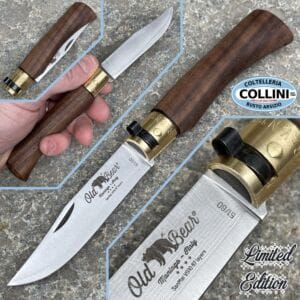
Antonini knives - Old Bear knife in SanMai VG10 at 67 layers - 19cm - walnut - Limited Edition
Antonini artisans from Maniago have created an exclusive and limited series of OLD BEAR knives using the famous Japanese SANMAI steel in VG10 with 67 layers. This beautiful project combines the tradition of a successful knife, patented and built in Italy, with the history and qualitative excellence of Japanese steel, made with a production process that dates back to that used for the famous Japanese swords.
The thickness of the blade goes from 2 mm of the standard models to 2.5 mm of this exclusive series, in order to make the knife more robust and performing.
To make the knife even more exclusive, for each of the three sizes offered, 60 exclusive pieces have been created, with progressive numbering engraved on the blade
Type of production: semi artisanal
Production Lama: Italy
Blade: San Mai 67 VG10 damask stainless steel (60/61 HRC)
Handle: in walnut wood
Blade length: 80mm.
Blade thickness: 2.5mm.
Closed length: 109mm.
Thick when closed: 22mm.
Total length: 190mm.
Weight: 46g.
Closure: viro blockThe handles are made of antique and oiled walnut wood. Being a model without return spring, the fixing of the blade to the handle is ensured by a solid brass safety ring equipped with a special locking device (covered by patent n.1187282 filed again in 1985 by the Todesco company of Maniago which is an active partner of this project) which can be activated both in the open position and in the closed position.
As early as 1100, expert Japanese blacksmiths combined different materials together to give Katana swords cutting, strength and flexibility previously unknown. Inspired by this tradition, Berkel has created a series of Japanese SanMai steel knives.
The blade consists of a core layer of extremely hard VG-10 steel, which keeps it sharp for a long time, and two outer plates made of 33-layer damask stainless steel per side, for greater resistance to corrosion and torsion.
Characteristics of SanMai steel: These are different types of metals bonded together to create a composite that encloses and intensifies the strengths of the metals individually taken:
- Longer life of the cutting edge
thanks to the use of very high quality steels with high carbon content (VG10, CoS, Shiro) or sintered (SPG2), in the heart of the sheet (Core Steel), the blade, once hardened, achieves decidedly hardness and cutting performance higher than those achieved with the use of traditional steels.- Greater resilience
built with the principle of Japanese swords, multilayer steel is difficult to break thanks to the toughness of the central steel (Core Steel) and the elasticity of the steel used for the side facing (Stainless Steel).- Better corrosion resistance
the steel used for the external layers (Stainless Steel) guarantees the blade a high resistance to corrosion. The combination of the two or more materials used by Takefu Steel generates, at the galvanic level, a structure that improves the corrosion resistance even on the wire.- Easy processing even after heat treatment
although steel normally becomes harder after hardening, the lateral steel used in multilayer processing does not lose its softness and allows easy processing, drilling or welding even after heat treatment. For an optimal performance of the blade, cryogenic treatment is recommended.- Improvement of the aesthetic result
The knives made with multi-state steel or with a damascus pattern at the end of the processing are aesthetically elegant, refined and highly appreciated by collectors all over the world.For more information: Collini Steel
AE-9305/19_LN€90.16Only 2 leftOnly 2 left


Sports, Outdoor, Tactical, and Collectible Knives: The Collini Selection
For over 50 years, Coltelleria Collini has been a reference point in Italy for the world of specialized cutlery. Since 1968, we have been selecting sports, outdoor, professional, and collectible knives, collaborating exclusively with official brands, historical manufacturers, and master artisans.
In this category, you will find thousands of original knives, chosen for demanding collectors, EDC, outdoor, and bushcraft enthusiasts, as well as professional operators who require reliability, quality materials, and consistent performance over time.
Military & Tactical Knives
Knives designed for heavy-duty and professional use, where robustness and reliability are paramount. We select world-leading brands such as Extrema Ratio, Zero Tolerance, Ka-Bar, and Cold Steel. Fixed and folding blades developed to withstand extreme conditions.
Sports & Outdoor Knives
From trekking to hiking, from bushcraft to everyday carry (EDC). Discover the Italian excellence of Fox Knives and LionSteel, the Nordic solidity of Fallkniven, and great classics like Opinel and Spyderco.
Collectible & Rare Knives
Custom, vintage, limited edition, and discontinued knives. Through our Approved program, we acquire, evaluate, and certify private collections, offering our customers access to rare, display, and investment-grade blades.
Why choose Coltelleria Collini since 1968
We are not just an e-commerce site, but a historic cutlery shop with direct experience on the products we offer. Buying from us guarantees:
- Certified Originality: we are official dealers for all brands we carry.
- Real Stock with fast shipping.
- Qualified Assistance and technical advice before and after sales.

Knives FAQ
There is no absolute "best" brand, but specific leaders for each use. For tactical and professional use, Extrema Ratio and Zero Tolerance are top tier. For outdoor and EDC, Fox, LionSteel, Fallkniven, and Spyderco excel.
Yes, buying sports and collectible knives online is generally legal for adults. However, laws regarding carrying and transporting knives in public vary significantly by country. Always check your local regulations.