


vegetables knives
-
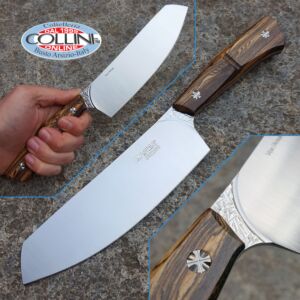
Viper - Sakura Bocote - Santoku 16cm by Vox & Anso - VT7516BC - vegetable knife
Viper's Sakura Knives, designed by Jens Anso and Jesper Voxnaes, are a modern interpretation of the classic kitchen knife.
Featuring a hardening with a subsequent cryogenic finish to provide the best cutting and sealing properties, they have gorgeous Bocote Hot Wood Handles that adds character and sophistication to design.
Recommended uses: Vegetables, raw meat, fish
Country of Origin: Italy - Maniago (PN)
Blade material: Nitro-B 58 / 59HRC stainless steel
Handle material: Bocote stabilized wood
Blade length: 16cm
Blade thickness: 3mm
Design by Jens Anso & Jesper VoxnaesVT7516BC€94.26Only 1 leftOnly 1 left
-
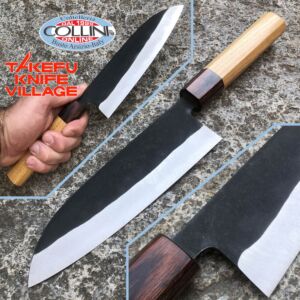
Takefu Village - Bunka knife - Aogami 3-layered steel - 16.5 cm - Japanese craftsmanship
Takefu Knives Village is a brand born in 1991 in Echizen Fukui, a city in Japan famous since 1400 for the production of knives.
The Takefu knives brand is based on the union of 10 local craftsmen who forge each knife by hand
Knife features: Mr. Shiro Kamo
Use: meat / fish / vegetables
Blade: in clad steel with Aogami 2 cutting edge at 62 / 63HRC
Lama origin: Japan
Handle: keyakyWood, Keyaki Zelkova wood (Japanese elm)
Packaging: cardboard with Japanese writing
Blade length: 165mm
Total length: 304mm
Blade thickness: 2.2mm
Handle length: 130mm
Weight: 126g* Not every knife is signed on the blade by the craftsman who made it
G-409-KY€122.95 Out of stock
 -
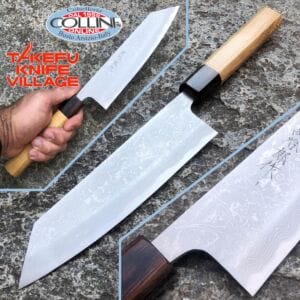
Takefu Village - Funayuki Knife 180mm - SanMai Shirogami 2 - by Mr. Masanobu Okada - kitchen knife
Takefu Knives Village is a brand born in 1991 in Echizen Fukui, a city in Japan famous since 1400 for the production of knives.
The Takefu knives brand is based on the union of 10 local craftsmen who make each knife by hand.The model presented is made by:
Mr. Masanobu Okada
Born in the city of Echizen in 1949, the third generation of forging craftsmen, he is one of the few living heirs of the "masaoki-ho" typical of Echizen, a forging technique that consists in repeating and folding the hammer steel giving it a rhomboid shape for obtain a thinner, sharper and easier to sharpen steel sheet.
Knife features:Use: meat / fish / vegetables
Blade: CladSteel carbon steel with cutting edge in White Paper Steel (Shirogami) at 62 / 64HRC and damask at 67
Lama origin: Japanese craftsmanship
Handle: Keyaki Zelkova (Japanese elm)
Packaging: cardboard with Japanese writing
Blade length: 184mm
Total length: 336mm
Blade thickness: 3.9mm
Handle length: 140mm
Weight: 179g* Not every knife is signed on the blade by the craftsman who made it
Maintenance:
Considering the high carbon steel used for the blade and the extreme construction quality of these knives, we recommend a series of attentions to follow to maintain the quality of the product over time.- Never put the knife in the dishwasher
- Rinse the knife with warm water before the first use
- Rinse the knife immediately after each use without aggressive dishwashing detergent and dry with a soft cloth (always starting at the back of the cutting edge)
- Aggressive foods such as lemon juice must be immediately rinsed immediately after use
- Do not use glass or granite slabs as a cutting support. Use only wooden bases
- Take care that the blade edge of the knife does not come into contact with other metal objects during its storage to avoid damage to the blade edge.OKD-180FUB€270.49Only 0 leftOnly 0 leftOut of stock -

Takefu Village - Kaku Usuba 170mm by Mr. Hideo Kitaoka - kitchen knife
Takefu Knives Village is a brand born in 1991 in Echizen Fukui, a city in Japan famous since 1400 for the production of knives.
The Takefu knives brand is based on the union of 10 local artisans who make every knife by hand.The model presented is realized by:
Mr. Hideo Kitaoka
Born in the city of Echizen in 1950, third generation forging craftsmen, he specializes in knives with Kataba blade (concave blade on the left side of the wire, chisel blade on the right side of the wire) also receiving the title of Dentoukougeishi (traditional craftsman) after subjected to the strict examination of the Traditional Crafts Industry Promotion Association Foundation commission.
Its knives are made with a White Paper Steel (Shirogami) cutting edge with a hardness of over 62 / 64HRC and with "Suminagashi" damask steel laminated cheeks. The handles are made as usual in sandalwood and Asian buffalo horn.
The Kanji characters printed on its blades 越 前 英雄 作 mean Echizen Hideo Saku (made by Hideo of Echizen)
Characteristics of the knife:Use: vegetables
Blade: CladSteel carbon steel with White Paper Steel (Shirogami) cutting edge at 62 / 64HRC and 33-layer "Suminagashi" damask
Provenance Lama: Japanese craft
Handle: Sandalwood, very hard and water resistant wood
Packaging: in cardboard with Japanese lettering
Blade length: 170mm
Total Length: 330mm
Blade thickness: from 4.5mm to 1.3mm
Handle Length: 134mm
Weight: 175g* Not every knife is signed on the blade by the craftsman who made it
Maintenance:
Given the high carbon content steel used for the blade and the extreme build quality of these knives, we recommend a series of attentions to follow to maintain the quality of the product over time.- Never place the knife in the dishwasher
- Rinse the knife with hot water before first use
- Rinse the knife immediately after each use without aggressive dishwashing detergent and dry with a soft cloth (always starting at the back of the cutting edge)
- Aggressive foods such as lemon juice must be promptly rinsed immediately after use
- Do not use glass or granite slabs as a cutting support. Use only wooden bases
- Pay attention that the cutting edge of the knife does not come into contact with other metal objects during its deposit to avoid damage to the cutting edge.C-106€204.92Only 0 leftOnly 0 leftOut of stock -
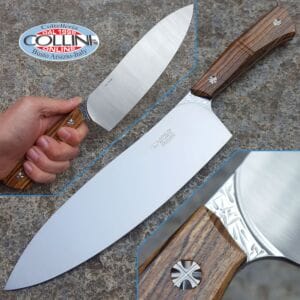
Viper - Sakura Bocote - Chef 18cm by Vox & Anso - VT7518BC - vegetable knife
Viper's Sakura Knives, designed by Jens Anso and Jesper Voxnaes, are a modern interpretation of the classic kitchen knife.
Featuring a hardening with a subsequent cryogenic finish to provide the best cutting and sealing properties, they have gorgeous Bocote Hot Wood Handles that adds character and sophistication to design.
Recommended uses: Vegetables, raw meat, fish
Country of Origin: Italy - Maniago (PN)
Blade material: Nitro-B 58 / 59HRC stainless steel
Handle material: Bocote stabilized wood
Blade Length: 18cm
Blade thickness: 3mm
Design by Jens Anso & Jesper VoxnaesVT7518BC€98.36Only 0 leftOnly 0 leftOut of stock -
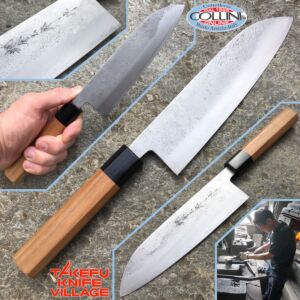
Takefu Village - Santoku Knife 180mm by Mr. Kanehiro Kintaro - kitchen knife
Takefu Knives Village is a brand born in 1991 in Echizen Fukui, Japan's famous city since the 1400s for knives production.
The Takefu knives brand is based on the union of 10 local artisans who make every knife by hand.The model presented is made by:
Mr. Kanehiro Kintaro
Kanehiro-san knives have gained popularity among professional chefs for the highest construction level and the high performance and cutting performance.
Knife Features:Use: meat / fish / vegetables
Blade: Clad Steel (Steel Hammer Forged, San Mai) Steel with Aogami cutting edge super carbon steel core 62 / 63HRC with 3 layers
Origin Knife: Japanese craftsmanship
Handle: Cherry wood
Packing: in cardboard with Japanese writing
Length Blade: 170mm
Total Length: 315mm
Thickness Blade: 4mm to 1mm
Length Grip: 125mm
Weight: 134g* Not every knife is signed on the blade by the craftsman who made it
D-503€184.43Out of stock -

Takefu Village - Petty Utility Knife 150mm by Mr. Masanobu Okada - kitchen knife
He was born in 1949 and is the 3rd generation of Okada Uchihamono. He is originally a blacksmith of gardening tools such as a sickle. In recent years, he has started to produce unique kitchen knife like your bought Takobiki. The Traditional Craftsman is the so-called Dentoukougeishi (Traditional Craftsman) which is the Accreditation Examination conducted by the Traditional Crafts Industry Promotion Association Foundation in accordance with Section 8 of Section 24 of the Act on Promotion of Traditional Craft Industries
Knife Features:
Use: vegetables / meat / fish
Blade: CladSteel carbon steel with 62 / 64HRC White Paper Steel (Shirogami) cutting edge and 33-layer Damask "Suminagashi"
Origin Knife: Japanese craftsmanship
Handle: SandalWood, very hard and water resistant
Packing: in cardboard with Japanese writing
Blade Length: 150mm
Total Length: 275mm
Thickness Blade: 3mm
Length Grip: 114mm
Weight: 86gF-211€110.65Out of stock -

Takefu Village - Petty Utility Knife 120mm by Mr. Masanobu Okada - kitchen knife
He was born in 1949 and is the 3rd generation of Okada Uchihamono. He is originally a blacksmith of gardening tools such as a sickle. In recent years, he has started to produce unique kitchen knife like your bought Takobiki. The Traditional Craftsman is the so-called Dentoukougeishi (Traditional Craftsman) which is the Accreditation Examination conducted by the Traditional Crafts Industry Promotion Association Foundation in accordance with Section 8 of Section 24 of the Act on Promotion of Traditional Craft Industries
Knife Features:
Use: vegetables / meat / fish
Blade: CladSteel carbon steel with 62 / 64HRC White Paper Steel (Shirogami) cutting edge and 33-layer Damask "Suminagashi"
Origin Knife: Japanese craftsmanship
Handle: SandalWood, very hard and water resistant
Packing: in cardboard with Japanese writing
Length Blade: 120mm
Total Length: 245mm
Thickness Blade: 3mm
Length Grip: 114mm
Weight: 78gF-209€102.46Out of stock -

Takefu Village - Kamausuba Knife 180mm by Mr. Hideo Kitaoka - kitchen knife
Mr. Hideo Kitaoka
He was born in 1950 and is the 3rd generation of Kitaoka Hamono. He has been a specialist of Kataba (single-beveled) knife from the beginning. He is also Dentoukougeishi.Knife Features:
Use: vegetable / fish
Blade: CladSteel carbon steel with 62 / 64HRC White Paper Steel (Shirogami) cutting edge and 33-layer Damask "Suminagashi"
Origin Knife: Japanese craftsmanship
Handle: SandalWood, very hard and water resistant
Packing: in cardboard with Japanese writing
Length Blade: 170mm
Total Length: 320mm
Thickness Blade: 4mm to 2mm
Length Grip: 132mm
Weight: 166g* Not every knife is signed on the blade by the craftsman who made it
C-827€245.08Out of stock -

Takefu Knives Village Serie Mina Santoku 17 cm coltello artigianale giapponese
Takefu Knives Village è un marchio nato nel 1991 a Echizen Fukui, città del Giappone famosa dal 1400 per la produzione di coltelli.
Il brand Takefu knives si fonda sull'unione di 10 artigiani locali che forgiano a mano ogni coltello
L'acciaio delle lame, prodotto dalla Takefu Steel, viene realizzato con la tecnica del "clad steel" tagliente in VG10 a 61HRC e placche laterali in damasco laminato.
Caratteristiche del coltello:
Impiego: carne/pesce/verdura
Lama: in acciaio CladSteel con tagliente in inox VG-10 a 60/62HRC
Provenienza Lama: Giappone
Impugnatura: SandalWood, legno molto duro e resistente all'acqua
Confezione: in cartone con scritte giapponesi
Lunghezza Lama: 170mm
Lunghezza Totale: 310mm
Spessore Lama: 2,5mm
Lunghezza Impugnatura: 127mm
Peso: 116g
* Non ogni coltello viene firmato sulla lama dall'artigiano che l'ha realizzatoMINA-170SA€204.92Out of stock -

Takefu Knives Village Serie Mina Petty 15 cm coltello artigianale giapponese
Takefu Knives Village è un marchio nato nel 1991 a Echizen Fukui, città del Giappone famosa dal 1400 per la produzione di coltelli.
Il brand Takefu knives si fonda sull'unione di 10 artigiani locali che forgiano a mano ogni coltello
L'acciaio delle lame, prodotto dalla Takefu Steel, viene realizzato con la tecnica del "clad steel" tagliente in VG10 a 61HRC e placche laterali in damasco laminato.
Caratteristiche del coltello:
Impiego: carne/pesce/verdura
Lama: in acciaio CladSteel con tagliente in inox VG-10 a 60/62HRC
Provenienza Lama: Giappone
Impugnatura: SandalWood, legno molto duro e resistente all'acqua
Confezione: in cartone con scritte giapponesi
Lunghezza Lama: 115mm
Lunghezza Totale: 280mm
Spessore Lama: 2,0mm
Lunghezza Impugnatura: 115mm
Peso: 78g
* Non ogni coltello viene firmato sulla lama dall'artigiano che l'ha realizzatoMINA-150PT€146.72Out of stock


Professional Kitchen Knives: Complete Guide to the Perfect Choice
Choosing a professional kitchen knife means improving precision, safety, and pleasure in cooking. For over 50 years, Coltelleria Collini has been selecting and testing the best international kitchen knives, collaborating exclusively with official brands and historical manufacturers. Whether you are a chef, an advanced enthusiast, or a demanding home cook, here you will find cutting tools designed to last over time and guarantee consistent performance.
In this category, you will find a complete selection of Japanese, German, Italian, and professional kitchen knives, chosen by blade type, steel, hardness (HRC), and ergonomics, to cover every cooking style and cutting technique.
Japanese Knives & Damascus
Razor-sharp edges, very acute cutting angles, and high-hardness steels (up to 61–63 HRC). The Japanese tradition of Seki is represented by brands like Kai and Miyabi (Zwilling Group), the CROMOVA steel of Global, and the versatility of Kai Wasabi. Ideal for those seeking pure cutting performance, precision, and control.
European Tradition – Forged
Robust, balanced, and easy-to-sharpen knives, designed for intensive daily use. German excellence from Solingen with Wüsthof and Zwilling, combined with the Swiss practicality of Victorinox. The ideal choice for professional kitchens, catering, and advanced home use.
Made in Italy & Blade Types
Italian artisanal tradition with Coltellerie Berti, Due Cigni, and Sanelli. Choose the right knife for every preparation: Chef's Knife, Santoku, as well as complete sets and steak knives.
Why buy kitchen knives from Coltelleria Collini
We don't just sell "blades," but tools for work and passion. Since 1968, Coltelleria Collini has been a reference point for chefs, professionals, and cooking enthusiasts.
- Official Retailers for all featured brands, with guaranteed authenticity.
- Professional sharpening service in-house to restore the edge.
- Real consultation: we help you choose between Chef, Santoku, Nakiri, or Slicing knives.

Kitchen Knives FAQ
Japanese knives are harder, with sharpening angles around 15°, ideal for extremely precise but more delicate cuts. European knives (German and Italian) are more robust, easier to resharpen, and more tolerant to impact, perfect for intensive use.
No, it is strongly discouraged. Aggressive detergents, high temperatures, and impacts damage the edge and the blade surface. It is always preferable to wash knives by hand and dry them immediately after use.