


Sport, Military and Collectible Knives | Coltelleria Collini
-

SharpX - Edge Fix - Manual Sharpener with Self-Adjusting System and Diamond/Ceramic Bars
Sharpx Edge Fix is a Swedish-designed manual sharpener created to deliver professional results in a simple and consistent manner. Thanks to its patented Self-Adjusting Angle (SAF) system, it allows you to achieve a precise edge without requiring any experience, working in two stages: sharpening with a diamond bar and finishing with a ceramic bar. Compact, stable, and intuitive, it is the ideal solution for keeping your knives in top condition.
With an elegant and functional design, the Sharpx Edge Fix is designed to accommodate any type of knife, ensuring precise sharpening without damaging the blade. It is lightweight and compact, making it easy to store and perfect for those with limited kitchen space.
Ease of use: You don’t need to be an expert to achieve professional results.
Quality materials: Made with durable components that ensure a long product life.
Safety: Designed with a non-slip base that ensures stability during use.KEY FEATURES
– Suitable for knives with steel blades
– Also suitable for knives with asymmetrical edges, such as sushi knives (yanagiba, deba, etc.)
– Two different sharpening angles: European (20°) or Japanese (15°)
– Patented technology with self-adjusting function (SAF, Self Adjusting Function)
– Diamond grit (#400) for sharpening and ceramic grit (#1000) for maintenance and polishing
– Large sharpening surface (1445 mm²)
– The sharpening rods slot into the base when not in use
– Silicone feet for greater stability and safety
– Self-draining function, easily washable under running waterPACKAGE CONTENTS
- Sharpening base
- 2 sharpening rods with a diamond-coated side and a ceramic side
- User manual
- Test cardTECHNICAL SPECIFICATIONS
– Product weight: 787 g
– Dimensions when closed: 46 x 143 x 143 mm
– Country of manufacture: ChinaSX5302€138.52Only 4 leftOnly 4 left -

Red Claw - Kubo Tac Training tool with sheath - kubotan - FK139A - plastic material
Intended use: training / sports use
Type of production: Industrial
Country of production: Italy
Materials: 15% glass fiber reinforced Nylon plastic material
Thickness: 18mm.
Total length: 139mm.
Weight: 42g.
Packaging: cardboard box
Sheath: 15% glass fiber reinforced nylon plastic with belt clip and spring attachmentWhat is kubotan, what is it for and what origins does it have?
The yawara (also called pasak or dulodulo in Filipino martial arts) is a Japanese instrument used in various martial arts. It is also called Kubotan, even if the origin of the latter has relevance to the USA police of Los Angeles, who used yawara karate techniques, to form a self-defense tool, useful both to stop any aggressors without bloodshed, and to teach citizens to defend themselves without the use of dangerous tools.
The Yawara originated from the use of Kongou, a Buddhist symbolic object, by monks in feudal Japan. The Yawara takes the form of one or two small, thick sticks that protrude about an inch from each side of the hand. They are usually used in pairs to initiate throws, bone breaks, and pressure point strikes.RC-FK139A€28.69Only 1 leftOnly 1 left
-

Red Claw - Panthera Training Knife Blue - marker knife - training knife
Marker training knife, ideal tool for training in the various personal defense disciplines, military training or to be used for soft air.
Thanks to the marker placed on the edge, at the tip and for 2 cm on the back of the blade, it is possible to mark the affected area with extreme precision.
Intended use: training and sports use
Type of production: Industrial
Country of production: Italy
Materials: 15% glass fiber reinforced Nylon plastic material
Blade length: 90mm.
Blade thickness: 8mm.
Total length: 225mm.
Weight: 120g.
Sheath: 15% glass fiber reinforced Nylon plastic with belt clip and possibility of 360° rotation
Packaging: knife, sheath, screwdriver, ink refill, interchangeable plastic blade, 2 fiber blades for marker use
Notes: Design by Roberto RisicatoSpecifications:
* autonomy of one recharge up to 400 cuts
* 1.5 mm thick stainless steel insert to give rigidity and weight
* custom logo
* red ink
* washable non-toxic and anti-allergenic ink
* red ink* serrated blade to distinguish
- threat - - - - - -
- assault -----------* 15% glass fiber reinforced Nylon plastic material
* interchangeable blade
- fiber for marker use
- plasticFor multiple purchases the training knife can be customized with logos
RC-PT-T-BL€61.48Only 0 leftOnly 0 leftOut of stock -

Red Claw - Panthera Training Knife Black - marker knife - training knife
Marker training knife, ideal tool for training in the various personal defense disciplines, military training or to be used for soft air.
Thanks to the marker placed on the edge, at the tip and for 2 cm on the back of the blade, it is possible to mark the affected area with extreme precision.
Intended use: training and sports use
Type of production: Industrial
Country of production: Italy
Materials: 15% glass fiber reinforced Nylon plastic material
Blade length: 90mm.
Blade thickness: 8mm.
Total length: 225mm.
Weight: 120g.
Sheath: 15% glass fiber reinforced Nylon plastic with belt clip and possibility of 360° rotation
Packaging: knife, sheath, screwdriver, ink refill, interchangeable plastic blade, 2 fiber blades for marker use
Notes: Design by Roberto RisicatoSpecifications:
* autonomy of one recharge up to 400 cuts
* 1.5 mm thick stainless steel insert to give rigidity and weight
* custom logo
* red ink
* washable non-toxic and anti-allergenic ink
* red ink* serrated blade to distinguish
- threat - - - - - -
- assault -----------* 15% glass fiber reinforced Nylon plastic material
* interchangeable blade
- fiber for marker use
- plasticFor multiple purchases the training knife can be customized with logos
RC-PT-T-B€61.48Only 0 leftOnly 0 leftOut of stock -
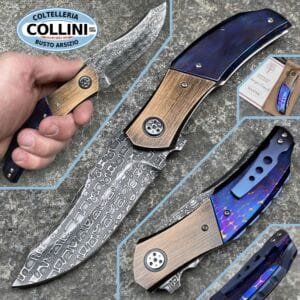
Sergio Consoli - Folder Damascus Spirograph - Timascus and bronze Handle - N ° 454 - handcrafted knives
Intended use: Collection
Type of production: Artisan by CIC Master Sergio Consoli
Production Lama: Italy
Blade: In spirograph damascus steel
Blade treatment: -
Handle: bronze bolsters, timascus with titanium spacers
Blade length: 95mm.
Blade thickness: 4mm.
Total length: 225mm.
Weight: 243g.
Closure: Liner Lock
Clip: titanium
Notes: Handmade by Master Sergio Consoli - knife number 454 made in 2018Acknowledgments
Currently I make a limited number of knives a year and participate in some exhibitions, where among other things I have won my first prizes:
in 2005 at LAME SOTTO I PORTICI in Romano di Lombardia (BG) I was awarded as "best table on display"
always in the same year at the CULTER-EXPO in Novegro (MI) as "best folding knife"
I was also ranked second in the competition organized by the magazine LAME D'AUTORE as the best fixed hunting blade
then in 2007 at "Scarperia" I won the third prize for best folding
but above all again in 2007, to my great satisfaction, I reached the degree of MASTER OF THE ITALIAN KNIVING CORPORATION, a recognition received at the first exam.
Presentation of the craftsman
Creating a knife by hand is what I consider a real art form.
The satisfaction of seeing an object that comes from one's own hands, that takes shape and reaches mechanical, artistic and aesthetic perfection is what pays me back the most for all the hours of work and effort it takes to create a knife completely. by hand.The passion for "cutting tools" has always been in me since I was a child and grew with me until the almost sudden decision to build my first knife myself, it was a "need", almost an inner necessity that I couldn't put off, my hands and my mind had to start creating, of course, what I had always been passionate about ... the knife!
I started at 40, in 2003, practically self-taught, I had no experience of manual work, but I had been a mechanical designer for many years and this allowed me to perfectly know the technique and all the various stages of mechanical processing.
Currently I am a member, with the rank of Master, which is the highest, of the Italian Knives Guild, an association recognized all over the world for the seriousness and above all quality of execution that all its members must maintain over time.
What I do now is what I consider my art form ..., to create "handcrafted, hunting and collectible knives".
They are knives made entirely by hand, only with an infinite series of files, a small drill for the holes and a sander for the concave grinding of the blades, nothing else!
I mainly make folding knives, which satisfy my desire to build perfect mechanical objects and perfection in the smallest details, even inside where they are not seen, is what distinguishes a knife created by hand, from one made industrially .The mechanics then must be made in the best possible way, without counting the hours of work, only in this way the final result is guaranteed.
Of course, over the years I have refined my technique and currently I have improved the mechanics even more by inserting a system of ball bearings on the blade rotation, which guarantee an absolutely perfect seal and allow the blade to close and open without the slightest friction. and with an incredible sweetness.
With regard to the blades then, I am experimenting with new types of hardening, which give hardnesses of 62-63 HRC and allow an exceptional edge hold and cutting quality for all types of use.
I make practically all the knives on an initial design of mine, they are all unique pieces made completely by hand down to the smallest details, one at a time, only in this way, in my opinion, a knife can be considered "artisanal".
Regarding the materials I use, I can say that for the blades I prefer RWL34 steel which is sintered from powders and guarantees the total absence of internal defects, sometimes I also use damascus, both stainless steel and carbon, for the uniqueness 'that give the knife, since each damask is always different from another.
For the handles, one of the most beautiful materials is the mammoth tooth, which can be found in a variety of wonderful colors, I also use fossil mammoth ivory, various briars, titanium and carbon fiber.
Most of the knives, however, are made entirely of steel, in order to then be engraved, always and strictly by hand, to transform the knife even more into a real work of art ...
SC-454€0.00Only 0 leftOnly 0 leftOut of stock -

BenchMark - Training Bali - BM006 - Training knife
*** ATTENTION: THE PAYMENT OF THIS ARTICLE MAY NOT 'BE MADE WITH PAYPAL ***
Intended Use: Training
Type of production: Industrial
Country of Origin: USA
Blade: stainless steel 420
Blade treatment: -
Handle: Full steel washers steel
Blade length: 95mm.
Blade thickness: 2.5mm.
Closed Length: 130mm.
Overall length: 230mm.
Thick when closed: 7.5mm
Weight: 165g.
Closed: T-latch
Packaging: Cardboard box with BenchMark logos
Notes: solid, sturdy, with hinged and riveted handles on the blade, great for making trick since it has the same weight, mass and balance of a real knife.BE-BM006€40.16Only 0 leftOnly 0 left Out of stock
 -
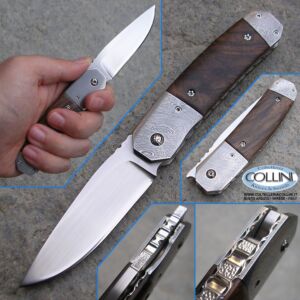
Sergio Consoli - N°098 Folding Walnut - Custom Knife
Blade: 61HRC RWL34 Stainless Steel
Handle: Walnut, Damascus and Titanium
Blade Lenght: 75mm.
Blade Thickness: 4mm.
Overall Lenght: 180mm.
Weight: 110g.
Lock: Liner lock
Clip: -
Sheath: -
Notes: Handmade in Italy by CIC Master Sergio Consoli9015€729.51Out of stock -

Red Claw - Kubo Tac Training tool - kubotan - K139A - plastic material
Intended use: training / sports use
Type of production: Industrial
Country of production: Italy
Materials: 15% glass fiber reinforced Nylon plastic material
Thickness: 18mm.
Total length: 139mm.
Weight: 42g.
Packaging: cardboard box
Note: -What is kubotan, what is it for and what origins does it have?
The yawara (also called pasak or dulodulo in Filipino martial arts) is a Japanese instrument used in various martial arts. It is also called Kubotan, even if the origin of the latter has relevance to the USA police of Los Angeles, who used yawara karate techniques, to form a self-defense tool, useful both to stop any aggressors without bloodshed, and to teach citizens to defend themselves without the use of dangerous tools.
The Yawara originated from the use of Kongou, a Buddhist symbolic object, by monks in feudal Japan. The Yawara takes the form of one or two small, thick sticks that protrude about an inch from each side of the hand. They are usually used in pairs to initiate throws, bone breaks, and pressure point strikes.RC-K139A€13.93Only 0 leftOnly 0 leftOut of stock


Sports, Outdoor, Tactical, and Collectible Knives: The Collini Selection
For over 50 years, Coltelleria Collini has been a reference point in Italy for the world of specialized cutlery. Since 1968, we have been selecting sports, outdoor, professional, and collectible knives, collaborating exclusively with official brands, historical manufacturers, and master artisans.
In this category, you will find thousands of original knives, chosen for demanding collectors, EDC, outdoor, and bushcraft enthusiasts, as well as professional operators who require reliability, quality materials, and consistent performance over time.
Military & Tactical Knives
Knives designed for heavy-duty and professional use, where robustness and reliability are paramount. We select world-leading brands such as Extrema Ratio, Zero Tolerance, Ka-Bar, and Cold Steel. Fixed and folding blades developed to withstand extreme conditions.
Sports & Outdoor Knives
From trekking to hiking, from bushcraft to everyday carry (EDC). Discover the Italian excellence of Fox Knives and LionSteel, the Nordic solidity of Fallkniven, and great classics like Opinel and Spyderco.
Collectible & Rare Knives
Custom, vintage, limited edition, and discontinued knives. Through our Approved program, we acquire, evaluate, and certify private collections, offering our customers access to rare, display, and investment-grade blades.
Why choose Coltelleria Collini since 1968
We are not just an e-commerce site, but a historic cutlery shop with direct experience on the products we offer. Buying from us guarantees:
- Certified Originality: we are official dealers for all brands we carry.
- Real Stock with fast shipping.
- Qualified Assistance and technical advice before and after sales.

Knives FAQ
There is no absolute "best" brand, but specific leaders for each use. For tactical and professional use, Extrema Ratio and Zero Tolerance are top tier. For outdoor and EDC, Fox, LionSteel, Fallkniven, and Spyderco excel.
Yes, buying sports and collectible knives online is generally legal for adults. However, laws regarding carrying and transporting knives in public vary significantly by country. Always check your local regulations.